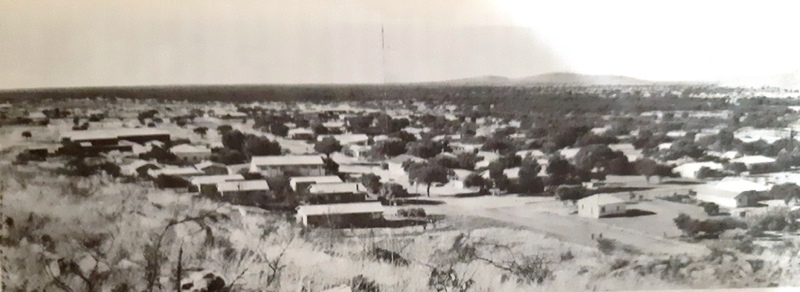
Olifantshoek
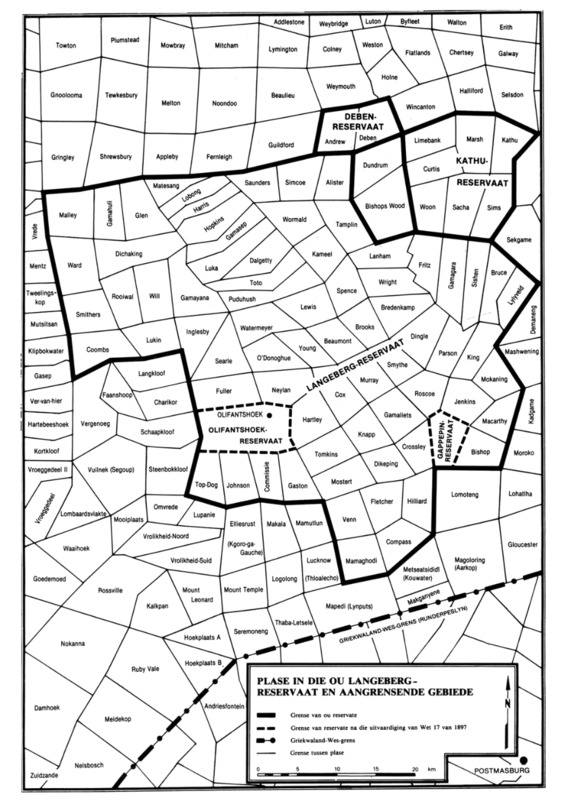
The Langberg, a slender north-south mountain range cutting across the Ghaap region, has been inhabited by San, Koranna and Tswana for centuries. The Koranna arrived in the area around 1770, and found a Tswana outpost already living in a significant settlement at Nokaneng (today the Nokanna farm), south of Olifantshoek. The Tswana called the Langberg “Majeng”, and the Olifantshoek area was called “Ditlou”, which means “elephants”. By the late 1700s, the Tswana moved further north, to Dithakong, but many Tlharo were still living there in the late 1800s. This area was a rich multi-cultural location where San, Griqua, Tswana, Basters, Korana and colonists mingled.
The name “Olifantshoek” was first recorded as in 1889. It was located within the land reserve of Toto Makgolokwe, a Tlharo chief.
During the 1890s, white colonists started moving into the area, purchasing farms from the Griqualand West authorities, and displacing the Tlharo. With Toto’s approval, white traders set up shop at remote sites such as Puduhush, Gamasep, Magahodi and Gamagara – places which often appear in the LMS church records.
In the aftermath of the rinderpest in the late 1890s, a general Tswana uprising took place. Race relations became increasingly tense, and the rebellion was brutally suppressed in May 1897. Many of the farm names around Olifantshoek bear the names of members of the white contingents. The tribal land was annexed (except for some “Native Reserves”), and the Thlaping and Thlaro tribes were scattered, leading to landlessness and impoverishment. Many had to find work on white farms or on the diggings.
After the Anglo-Boer War, the area remained desperately poor, due to unreliable water supplies, droughts, poor transport, locusts, wild animals, and severe livestock diseases. Poverty was widespread among all races. Traders used wagons and donkeys to sell their goods on the farms, or transported skins and wood to Kimberley for trade.
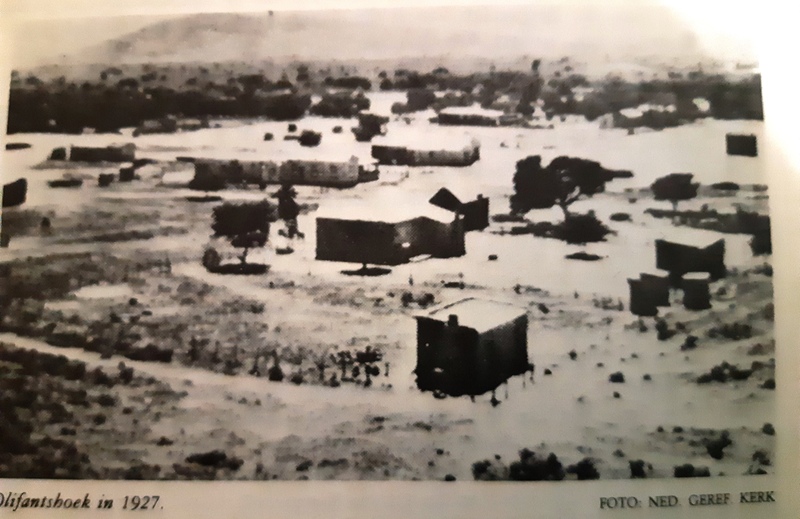
The London Missionary Society became a very important religious foundation for coloured and black people. The LMS built a church for coloured and black people in Olifantshoek in 1923. The legendary Rev Bart Haai visited Olifantshoek from his base at Danielskuil. In 1959, the LMS had 164 members in Olifantshoek, and 345 in the vicinity. He was followed by Rev HC Tompson. 1928, the LMS The NG Church established a Mission Church and school.
The NGH Church established a Mission Church in 1973 at Olifantshoek.
The local Gamagara Municipality is named after the Ga-Mogara River. Gamagara had been a Tlharo chief in the mid-1800s.