Danielskuil Community History
The Griqua occupied the site until 1826. Then Barend Barends led most of the Griqua clan to nearby Boetsap, where the grazing was better. But some Griqua remained at the site, and it also remained a missionary outpost.
During the late 19th Century, there was a slow process of dispossession of Griqua or "coloured" farms, particularly after the Griqua rebellion of 1878 in Griqualand West. Wite trekboers moved in after the 1850s, mainly as farmers and traders. By the late 1800s, white political and economic power was consolidated in a municipality and local church. The Rinderpest epidemic which affected livestock was a blow to all residents in the 1890s, and caused widespread poverty.
The London Missionary Society (LMS) remained the focus of Christian outreach in Danielskuil, with its bases in Griquatown and Kuruman. In 1898, the LMS built a church, which still stands.
During the Anglo-Boer War, many white farmers and townsfolk joined the Afrikaner rebellion in the Cape Colony. The English-speakers, and the local Griqua and Tswana, remained loyal to the British Empire. Danielskuil was occupied by British forces, who tried to quell the rebellion in the countryside. Local coloured people were often caught between the two sides. The town was not damaged, but the economy declined severely due to the British policy of stripping the farms of livestock and assets.
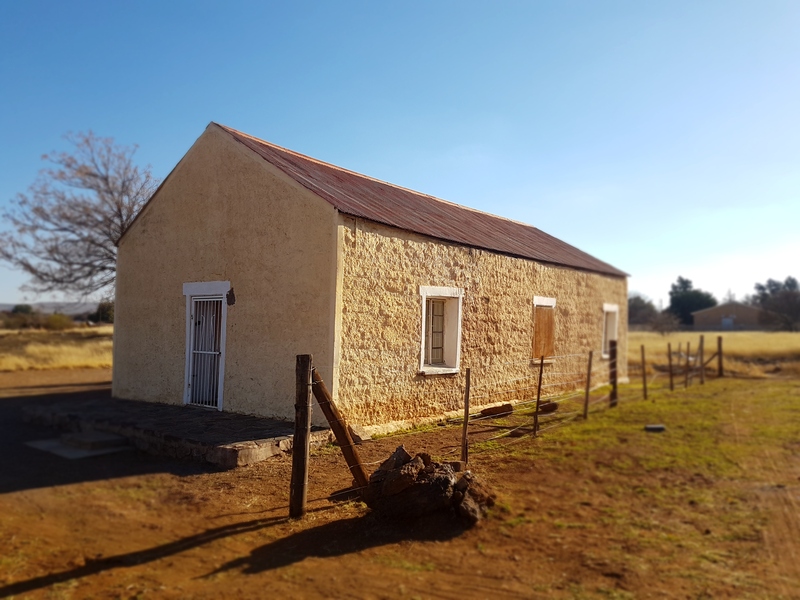
The LMS Church, over 130 years old, was for many years used as a school - and many elderly people still remember their formative years there.
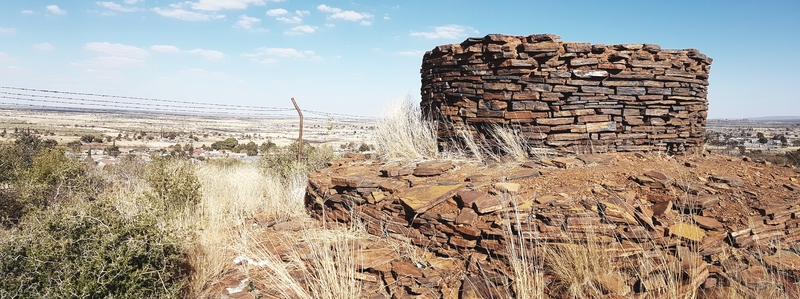
British Anglo-boer War Blockhouse
Danielskuil remained very poor after the war. There was slow economic growth and white consolidation of political and economic power. The NG Church was an important institution in the town, and the old church was built in 1894.
In 1920, the coloured community was moved from the northern side of town to an area called Marenteng (which means “fragment”), which still exists with small houses. Later, under apartheid, the modern coloured "township" of Kuilsville was created.
In the 1960s, Danielskuil was re-planned along racial lines. A new black township, Tlaka-la-Tlou, was established on the eastern side of town. All black and coloured residents in the central town were removed to the designated residential areas. There was increasing investment in local lime mining, which brought more prosperity, but also work-seeking migrants. The town expanded.
Danielskuil is a prosperous mining town today, dependent on the lime industry. The lime deposits were laid down at a very early geological age, about 3 billion years ago. A non-racial municipality (Kgatelopele LM) governs the town. There has been intense political competition between various political parties.
Our project began with an investigation of the “coloured” (largely Griqua) community history in Kuilsville, a suburb of Danielskuil. Many unmarked graves dot the cemetery - and this leads us to ask: Who lived and died in this community?
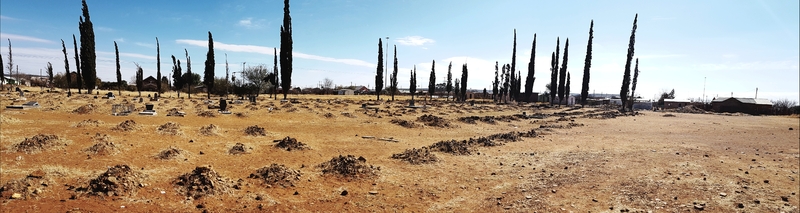
The Kuilsville cemetery, with its haunting nameless graves.
Two publications celebrate Danielskuil’s history:
- Doreen Atkinson, Danielskuil: ‘n Skatkis vol Stories, 2023, click here
- Ubique Heritage Resources cc (Heidi Fivaz and Jan Engelbrecht), Danielskuil: Heritage Inventory and Assessment (2021) click here
These publications were produced with the support of the National Heritage Council.